

- Industry Size (2026)
- USD 39.81 Bn
- Forecast (2036)
- USD 68.65 Bn
- CAGR (2026 to 2036)
- 5.60%
Test and Measurement Equipment Market Size, Market Forecast and Outlook By FMI
The test and measurement equipment market is expected to increase from USD 39.81 billion in 2026 to USD 68.65 billion by 2036. Market demand is anticipated to register a 5.60% CAGR from 2026 to 2036 across industrial and technology applications. Calibration Services are likely to lead with 67.4% share in 2026, and General-purpose Test Equipment is projected to account for 62.4% share by product type.
Summary of the Test and Measurement Equipment Market
- Demand and Growth Drivers
- Industrial automation programs are expected to raise instrument demand as factories require stable precision checks across production lines.
- 5G and semiconductor investments are likely to increase procurement of signal analyzers and precision systems across advanced facilities.
- Calibration compliance needs are anticipated to lift recurring service spending across laboratories and certified manufacturing operations.
- Product and Segment View
- Calibration Services are expected to lead the services segment as regulated users need repeatable measurement assurance across equipment life.
- General-purpose Test Equipment is likely to dominate product demand as electronics teams use versatile instruments across many test tasks.
- Electronics and semiconductor users are anticipated to create strong demand for precision systems across component testing programs.
- Geography and Competitive Outlook
- India is expected to record the fastest expansion as telecom rollout and domestic manufacturing programs increase instrument purchases.
- China is likely to maintain strong demand as semiconductor investment expands testing requirements across fabrication and electronics clusters.
- Established markets such as the USA and UK are anticipated to rely on replacement cycles and calibration renewal demand.
- Analyst Opinion
- Nikhil Kaitwade, Principal Consultant for Industrial Automation at FMI, suggests: “The test and measurement equipment market is expected to favor suppliers able to combine accurate instruments with dependable calibration programs. General-purpose platforms and certified service networks are likely to gain preference as electronics and telecom buyers press for consistent measurement performance.”
- Test and Measurement Equipment Market Value Analysis
- The test and measurement equipment market is moving from one-time hardware purchases toward service-led precision assurance programs.
- Demand is likely to rise as 5G rollout and semiconductor complexity require stronger validation across production environments.
- Adoption is expected to gain momentum through calibration contracts designed to reduce measurement risk across regulated industrial facilities.
- Spending is anticipated to increase as manufacturers prioritize reliable instruments for quality control and product validation.
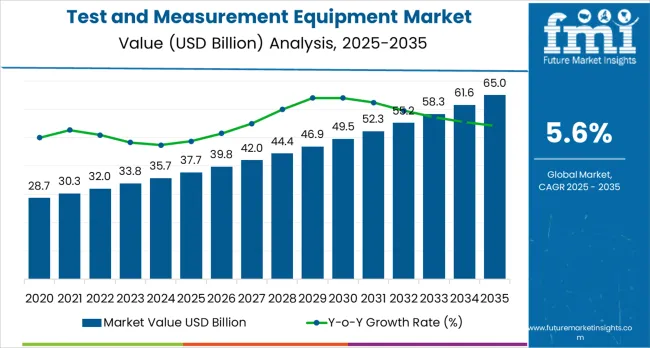
Key Takeaways, Market Size, and Forecast
| Metric | Value |
|---|---|
| Market Size (2026) | USD 39.81 Billion |
| Market Size (2036) | USD 68.65 Billion |
| CAGR (2026–2036) | 5.60% |
| Leading Services (2026) | Calibration Services |
| Calibration Services Share (2026) | 67.4% |
| Leading Product Type (2026) | General-Purpose Test Equipment |
| General-Purpose Test Equipment Share (2026) | 62.4% |
| Fastest-Growing Country | India |
| India CAGR | 8.3% |
Proliferation of 5G network deployments, miniaturized semiconductor architectures, and increased R&D expenditure across defense and automotive sectors are sustaining procurement of precision instruments. Calibration compliance requirements under ISO/IEC 17025 continue to push recurring service revenue for equipment manufacturers.
Regional demand is shaped by infrastructure rollout and manufacturing activity. India at 8.3%, China at 6.3%, Spain at 4.2%, USA at 3.1%, UK at 2.2%. India leads, driven by large-scale telecom and defense modernization programs. China follows, supported by semiconductor fabrication investments. Spain registers growth from renewable energy testing infrastructure. USA and UK sustain steady replacement demand.
Test and Measurement Equipment Market Key Takeaways
| Metric | Details |
|---|---|
| Industry Size (2026) | USD 39.81 billion |
| Industry Value (2036) | USD 68.65 billion |
| CAGR (2026 to 2036) | 5.60% |
Source: Future Market Insights, 2026
Test and Measurement Equipment Market Definition
Test and measurement equipment encompasses instruments and systems used to evaluate, verify, and calibrate electrical, mechanical, and environmental parameters across industrial, telecom, healthcare, and defense applications. The market includes general-purpose test equipment such as oscilloscopes, signal analyzers, and spectrum analyzers, alongside mechanical test equipment for stress and materials testing. Service revenues from calibration and after-sales support form a substantial portion of market value.
Test and Measurement Equipment Market Inclusions
Market scope includes general-purpose and mechanical test equipment, calibration services, and after-sales services. Coverage spans healthcare, electronics and semiconductor, IT and telecom, aerospace and defense, automobile and transportation, and education and government verticals, with global and regional market sizing from 2026 to 2036.
Test and Measurement Equipment Market Exclusions
The scope excludes consumer-grade multimeters, educational laboratory kits without industrial certification, and standalone software analytics platforms that do not bundle with physical test hardware. Environmental simulation chambers without integrated measurement systems are also excluded.
Test and Measurement Equipment Market Research Methodology
- Primary Research: Analysts engaged with procurement specialists, product engineers, and distribution channel managers to map decision criteria and adoption triggers across core verticals.
- Desk Research: Data collection aggregated regulatory filings, standards body publications, trade association reports, and public procurement records across covered geographies.
- Market-Sizing and Forecasting: Baseline values derive from a bottom-up aggregation of product-level shipments and service contracts, applying region-specific adoption curves to project future demand velocity.
- Data Validation and Update Cycle: Projections are tested against publicly reported capital expenditure guidance, trade statistics, and primary interview inputs from active market participants.
Why is the Test and Measurement Equipment Market Growing?
Market expansion rests on three fundamental shifts driving adoption across the electronics and telecommunications sectors.
1. 5G technology deployment creates compelling operational advantages through test equipment that provides immediate precision testing efficiency without measurement degradation, enabling manufacturing facilities to meet quality standards while maintaining production reliability and reducing testing complexity.
2. Electronics manufacturing modernization accelerates as facilities worldwide seek advanced systems that complement traditional testing methods, enabling precise measurement control and quality assurance that align with industry regulations and operational efficiency standards.
3. AI integration enhancement drives adoption from manufacturing facilities and telecommunications operations requiring effective testing solutions that minimize measurement error while maintaining operational performance during precision testing operations.
However, growth faces headwinds from equipment cost challenges that vary across industrial suppliers regarding the pricing of specialized testing equipment and measurement systems, which may limit adoption in budget-sensitive manufacturing environments. Technical limitations also persist regarding equipment capabilities and operational conditions that may reduce effectiveness in extreme precision ranges or challenging industrial environments, which affect testing performance and measurement consistency.
Opportunity Pathways - Test and Measurement Equipment Market
The test and measurement equipment market represents a specialized yet critical opportunity driven by expanding 5G infrastructure, manufacturing modernization, and the adoption of AI and automation platforms. The market will expand from USD 37.7B in 2025 to USD 65.0B by 2035, adding USD 27.3B in new value. Growth opportunities are concentrated around advanced general-purpose equipment, calibration services, precision testing optimization, and smart integration capabilities.
- Pathway A - General Purpose Equipment Leadership &Advanced Testing Optimization. Strengthening the dominant general-purpose segment through improved precision capabilities, automated measurement systems, and integration with manufacturing platforms. Expected revenue pool: USD 6.0-6.8B
- Pathway B - Asian Manufacturing Expansion &Market Development. Capturing demand from India and China's rapid industrialization growth through localized manufacturing and technology partnerships. Expected revenue pool: USD 4.6-5.3B
- Pathway C - Electronics Market Dominance &Performance Integration. Expanding within electronics applications via performance-optimized and quality-ready systems. Expected revenue pool: USD 3.8-4.5B
- Pathway D - Calibration Services &Precision Applications. Scaling service solutions for precision testing operations in demanding manufacturing environments. Expected revenue pool: USD 3.2-3.8B
- Pathway E - Telecommunications Innovation &5G Applications. Leveraging advanced testing capabilities to serve wireless communication and network demand. Expected revenue pool: USD 3.0-3.5B
- Pathway F - Industrial Automation Integration &Manufacturing Solutions. AI-enabled equipment with manufacturing monitoring and real-time quality control. Expected revenue pool: USD 3.0-3.5B
- Pathway G - Mechanical Testing &Advanced Performance Development. Designing equipment that meets higher precision ranges and enhanced testing standards. Expected revenue pool: USD 2.5-2.9B
Segmental Analysis
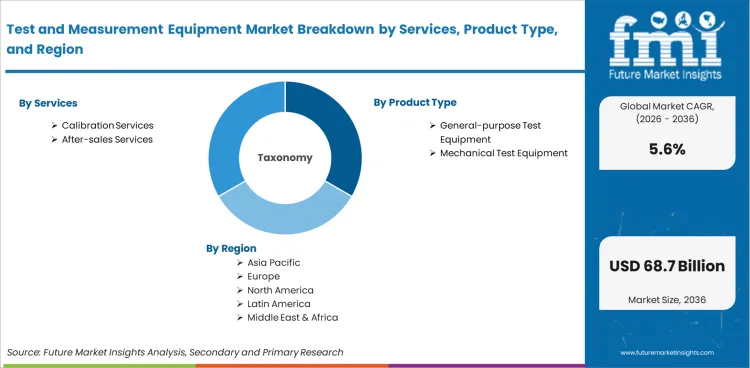
Primary Classification: The market segments by service into calibration services and after-sales services, representing the evolution from basic maintenance support to specialized precision solutions for comprehensive testing optimization.
Secondary Classification: Product type segmentation divides the market into general-purpose test equipment and mechanical test equipment, reflecting distinct requirements for operational performance, precision compliance, and system efficiency standards.
Tertiary Classification: Vertical segmentation covers healthcare, electronics and semiconductor, IT and telecommunication, aerospace and defense, automobile and transportation, and education and government applications.
Regional Classification: Geographic distribution covers North America, Latin America, Europe, Asia Pacific, and Middle East &Africa, with developed markets leading adoption while emerging economies show accelerating growth patterns driven by industrial expansion programs.
The segmentation structure reveals technology progression from standard testing equipment toward specialized precision systems with enhanced measurement capabilities and automation features, while application diversity spans from electronics manufacturing to telecommunications infrastructure requiring precise quality control solutions.
By Service, the Calibration Services Segment Accounts for Dominant Market Share
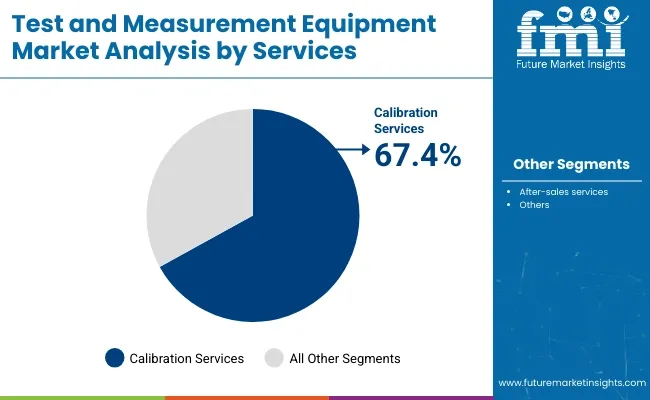
Market Position: Calibration services command the leading position in the test and measurement equipment market with 67.4% market share through advanced precision features, including superior accuracy capability, operational reliability, and quality optimization that enable manufacturing facilities to achieve optimal testing performance across diverse industrial and electronics environments.
Value Drivers: The segment benefits from manufacturing facility preference for reliable calibration systems that provide consistent measurement performance, reduced testing error, and operational efficiency optimization without requiring significant infrastructure modifications. Advanced service features enable automated quality control, precision consistency, and integration with existing testing equipment, where measurement performance and system reliability represent critical facility requirements.
Competitive Advantages: Calibration services differentiate through proven operational stability, consistent precision characteristics, and integration with automated testing systems that enhance facility effectiveness while maintaining optimal quality standards suitable for diverse manufacturing and electronics applications.
Key market characteristics:
- Advanced precision designs with optimized accuracy configuration and operational efficiency capabilities
- Extended calibration effectiveness, enabling 90-95% measurement success with consistent precision performance
- Manufacturing compatibility, including automated quality control, monitoring integration, and process optimization for testing operations
After-Sales Services Show Specialized Market Growth
After-sales services maintain a complementary market position in the test and measurement equipment market due to their specialized support properties and operational advantages. These services appeal to facilities requiring comprehensive maintenance characteristics with competitive performance for equipment lifecycle and technical support applications. Market growth is driven by equipment complexity emphasis, highlighting reliable service solutions and operational effectiveness through optimized support designs.
By Product Type, General Purpose Test Equipment Shows Fastest Growth
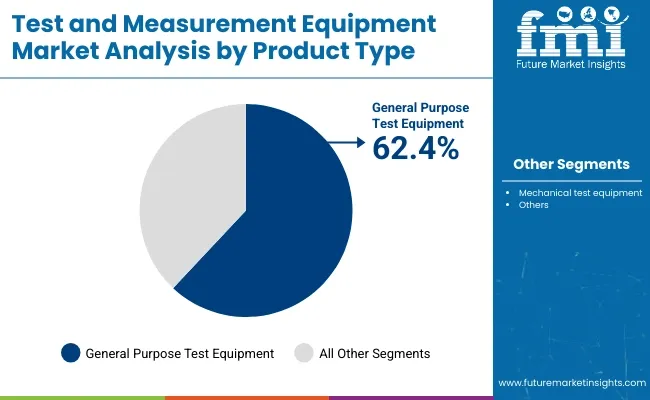
Market Context: General-purpose test equipment demonstrates the highest market share with 62.4% due to widespread adoption of versatile testing systems and increasing focus on manufacturing optimization, operational performance enhancement, and industrial applications that maximize precision efficiency while maintaining quality standards.
Appeal Factors: General-purpose equipment operators prioritize system reliability, measurement optimization, and integration with existing manufacturing infrastructure that enables coordinated testing across multiple industrial operations. The segment benefits from substantial manufacturing investment and modernization programs that emphasize the acquisition of versatile systems for performance enhancement and quality efficiency applications.
Growth Drivers: Manufacturing automation programs incorporate general-purpose equipment as standard equipment for industrial operations, while electronics facility growth increases demand for advanced testing capabilities that comply with performance standards and minimize operational complexity.
Market Challenges: Varying testing technology standards and equipment infrastructure differences may limit system standardization across different facilities or operational scenarios.
Application dynamics include:
- Strong growth in electronics manufacturing and telecommunications requiring versatile testing capabilities
- Increasing adoption in performance optimization and operational enhancement applications for manufacturing operators
- Rising integration with automated testing systems for operational optimization and efficiency assurance
Mechanical Test Equipment Applications Maintain Specialized Demand
Mechanical test equipment captures complementary market share through specialized testing requirements in automotive manufacturing facilities, aerospace operations, and precision materials applications. These facilities demand mechanical systems capable of operating in demanding environments while providing effective testing and operational reliability capabilities.
By Vertical, Electronics and Semiconductor Applications Drive Market Leadership
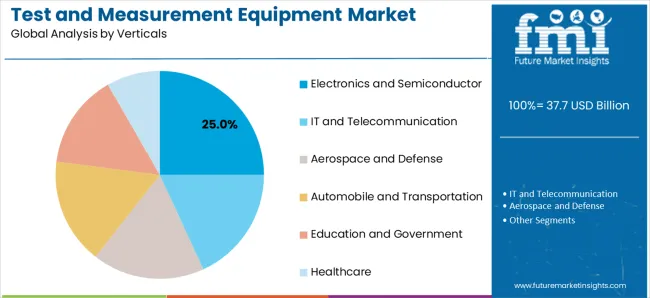
Market Position: Electronics and semiconductor applications lead the market with 25% share, representing the largest industry vertical segment due to extensive manufacturing infrastructure development and precision testing requirements.
Growth Drivers: Electronics sector expansion, technology modernization projects, and quality control enforcement drive consistent demand for testing solutions across manufacturing facilities, semiconductor production, and component testing projects.
Application Scope: Electronics applications span component testing, quality control, manufacturing optimization, and facility upgrade projects requiring diverse testing capabilities and precision measurement features.
What are the Drivers, Restraints, and Key Trends of the Test and Measurement Equipment Market?
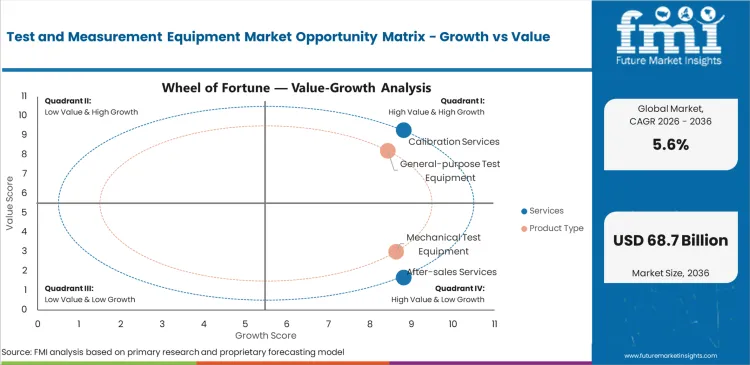
Growth Accelerators: 5G technology infrastructure development drives primary adoption as test equipment provides precision measurement efficiency capabilities that enable telecommunications facilities to meet quality standards without excessive testing complexity, supporting manufacturing operations and technology missions that require advanced measurement applications.
Industrial automation demand accelerates market expansion as facilities seek effective systems that minimize measurement error while maintaining operational effectiveness during quality control and testing scenarios. Electronics technology spending increases worldwide, creating continued demand for testing systems that complement traditional manufacturing methods and provide operational flexibility in complex industrial environments.
Growth Inhibitors: Equipment cost challenges vary across industrial suppliers regarding the pricing of specialized testing systems and measurement equipment, which may limit operational flexibility and market penetration in regions with budget constraints or cost-sensitive manufacturing operations.
Technical performance limitations persist regarding equipment capabilities and operational conditions that may reduce effectiveness in extreme precision ranges, environmental interference, or facility conditions, affecting testing performance and measurement consistency. Market fragmentation across multiple manufacturing specifications and testing standards creates compatibility concerns between different equipment suppliers and existing industrial infrastructure.
Market Evolution Patterns: Adoption accelerates in electronics and telecommunications sectors where performance requirements justify testing system costs, with geographic concentration in developed markets transitioning toward mainstream adoption in emerging economies driven by industrialization initiatives and quality control development.
Technology development focuses on enhanced testing capabilities, improved precision efficiency, and integration with automated monitoring systems that optimize measurement performance and manufacturing effectiveness. The market could face disruption if alternative testing technologies or measurement standards significantly limit the deployment of traditional testing equipment in manufacturing or electronics applications.
Analysis of the Test and Measurement Equipment Market by Key Country
.webp "Top Country Growth Comparison Test And Measurement Equipment Market Cagr (2026 2036)")
| Country | Growth Rate (2026-2036) |
|---|---|
| India | 8.3% |
| China | 6.3% |
| Spain | 4.2% |
| United States | 3.1% |
| United Kingdom | 2.2% |
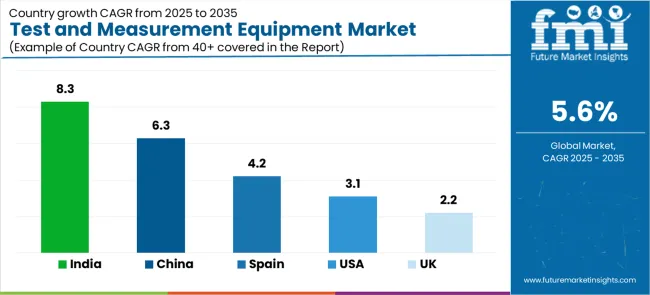
The test and measurement equipment market demonstrates varied regional dynamics with Growth Leaders including India (8.3% growth rate) and China (6.3% growth rate) driving expansion through manufacturing initiatives and electronics development.
Steady Performers encompass Spain (4.2% growth rate), United States (3.1% growth rate), and developed regions, benefiting from established industrial industries and advanced equipment adoption. Emerging Markets feature United Kingdom (2.2% growth rate) and developing regions, where technology initiatives and manufacturing modernization support consistent growth patterns.
Regional synthesis reveals Asian markets leading adoption through manufacturing expansion and electronics development, while North American countries maintain steady expansion supported by industrial technology advancement and quality standardization requirements. European markets show moderate growth driven by telecommunications applications and precision testing integration trends.
India Drives Fastest Market Growth
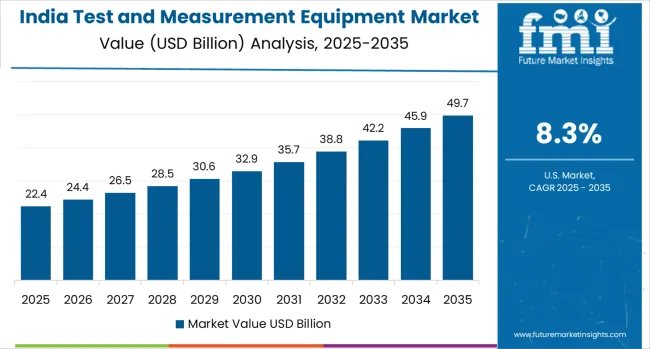
India establishes fastest market growth through aggressive manufacturing programs and comprehensive electronics development, integrating advanced test equipment as standard components in industrial infrastructure and technology installations. The country's 8.3% growth rate reflects government initiatives promoting industrial technology and domestic manufacturing capabilities that mandate the use of advanced testing systems in electronics and manufacturing facilities. Growth concentrates in major industrial centers, including Mumbai, Delhi, and Bangalore, where technology development showcases integrated testing systems that appeal to manufacturing operators seeking advanced facility optimization capabilities and quality control applications.
Indian manufacturers are developing cost-effective testing solutions that combine domestic production advantages with advanced operational features, including automated measurement control and enhanced precision capabilities. Distribution channels through industrial suppliers and equipment distributors expand market access, while government support for manufacturing infrastructure development supports adoption across diverse electronics and industrial segments.
Strategic Market Indicators:
- Manufacturing facilities leading adoption with 85% deployment rate in electronics and industrial infrastructure sectors
- Government technology programs providing substantial funding for domestic manufacturing technology development
- Local manufacturers capturing 40% market share through competitive pricing and localized technical support
- Export market development for cost-effective testing solutions targeting emerging manufacturing markets
China Emerges as High-Growth Market
In Beijing, Shanghai, and Shenzhen, manufacturing facilities and electronics operations are implementing advanced test equipment as standard equipment for quality control optimization and precision testing applications, driven by increasing government manufacturing investment and technology modernization programs that emphasize the importance of testing capabilities.
The market holds a 6.3% growth rate, supported by government industrial initiatives and electronics development programs that promote advanced testing systems for manufacturing and technology facilities. Chinese operators are adopting testing systems that provide consistent operational performance and measurement features, particularly appealing in industrial regions where precision efficiency and quality standards represent critical operational requirements.
Market expansion benefits from growing manufacturing technology capabilities and technology transfer agreements that enable domestic production of advanced testing systems for electronics and industrial applications. Technology adoption follows patterns established in manufacturing equipment, where reliability and performance drive procurement decisions and operational deployment.
Market Intelligence Brief:
- Manufacturing and electronics segments are driving initial adoption with 58% annual growth in equipment procurement
- Industrial modernization programs emphasizing testing systems for quality efficiency and measurement optimization
- Local manufacturers partnering with international providers for system development
- Manufacturing facilities implementing testing systems for operational optimization and quality control
United States Maintains Market Leadership
United States establishes market leadership through comprehensive industrial programs and advanced manufacturing infrastructure development, integrating test equipment across electronics and telecommunications applications.
The country's 3.1% growth rate reflects established industrial relationships and mature testing technology adoption that supports widespread use of precision measurement systems in manufacturing and technology facilities. Growth concentrates in major technology centers, including California, Texas, and New York, where industrial technology showcases mature equipment deployment that appeals to manufacturing operators seeking proven testing capabilities and operational efficiency applications.
American equipment providers leverage established distribution networks and comprehensive service capabilities, including technical support programs and performance optimization that create customer relationships and operational advantages. The market benefits from mature quality regulations and testing standards that mandate equipment use while supporting technology advancement and operational optimization.
Market Intelligence Brief:
- Manufacturing and technology facilities maintaining 80% adoption rate with mature equipment deployment
- Established quality regulations providing consistent demand for testing technology advancement
- Technology integration programs expanding equipment capabilities in manufacturing scenarios
- Industrial infrastructure investments driving demand for advanced testing solutions
Spain Shows Technology Leadership
The advanced industrial technology market in Spain demonstrates sophisticated test equipment deployment with documented operational effectiveness in manufacturing applications and electronics operations through integration with existing industrial systems and manufacturing infrastructure. The country leverages engineering expertise in industrial technology and quality control integration to maintain a 4.2% growth rate.
Technology centers, including Madrid, Barcelona, and Valencia, showcase premium installations where testing systems integrate with comprehensive manufacturing platforms and facility management systems to optimize quality control operations and measurement effectiveness.
Spanish manufacturers prioritize system reliability and performance compliance in testing equipment development, creating demand for premium systems with advanced features, including facility monitoring integration and automated quality control. The market benefits from established industrial technology infrastructure and a willingness to invest in advanced testing technologies that provide long-term operational benefits and compliance with international manufacturing standards.
Market Intelligence Brief:
- Engineering focuses on performance standardization and quality compliance, driving premium segment growth
- Industrial technology partnerships providing 30% faster development cycles
- Technology collaboration between Spanish manufacturers and international industrial companies
- Facility training programs expanding testing system integration in manufacturing scenarios
United Kingdom Shows Strong Technology Market
The United Kingdom's market expansion benefits from diverse industrial demand, including manufacturing infrastructure modernization in London and Manchester, technology facility upgrades, and government innovation programs that increasingly incorporate testing solutions for quality optimization applications. The country maintains a 2.2% growth rate, driven by rising industrial activity and increasing recognition of testing technology benefits, including precise measurement control and reduced quality interference.
Market dynamics focus on cost-effective testing solutions that balance advanced operational performance with affordability considerations important to British manufacturing operators. Growing industrial modernization creates continued demand for modern testing systems in new facility infrastructure and manufacturing modernization projects.
Strategic Market Considerations:
- Manufacturing and electronics segments leading growth with focus on quality optimization and precision control applications
- Regional industrial requirements driving a diverse product portfolio from basic testing equipment to advanced systems
- Technology partnership opportunities with potential local production agreements with international manufacturers
- Government innovation initiatives beginning to influence procurement standards and operational requirements
Europe Market Split by Country
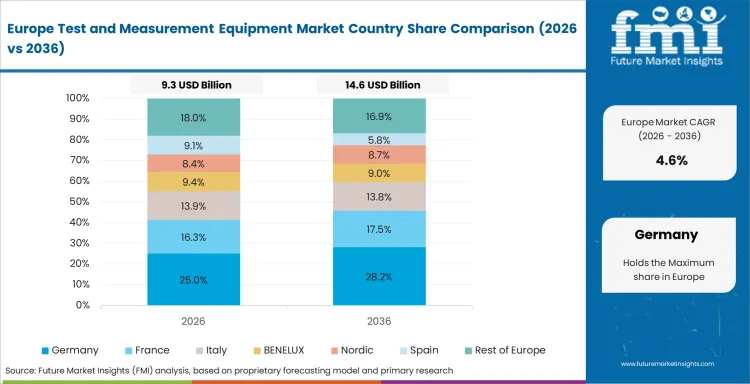
The European test and measurement equipment market is projected to grow from USD 11.3 billion in 2026 to USD 18.7 billion by 2036, registering a CAGR of 5.1% over the forecast period. Germany is expected to maintain its leadership position with a 26.4% market share in 2026, supported by its advanced industrial technology infrastructure and major manufacturing centers.
United Kingdom follows with a 20.8% share in 2026, driven by comprehensive technology programs and industrial development initiatives. France holds a 17.3% share through specialized manufacturing applications and quality control requirements. Italy commands a 13.9% share, while Spain accounts for 10.2% in 2026.
Poland maintains an 8.1% share, while Russia accounts for 3.3% of the European market in 2026. The Rest of Europe region is anticipated to gain momentum, expanding its collective share from 7.5% to 8.2% by 2036, attributed to increasing industrial adoption in Nordic countries and emerging manufacturing facilities implementing technology modernization programs.
Competitive Landscape of the Test and Measurement Equipment Market
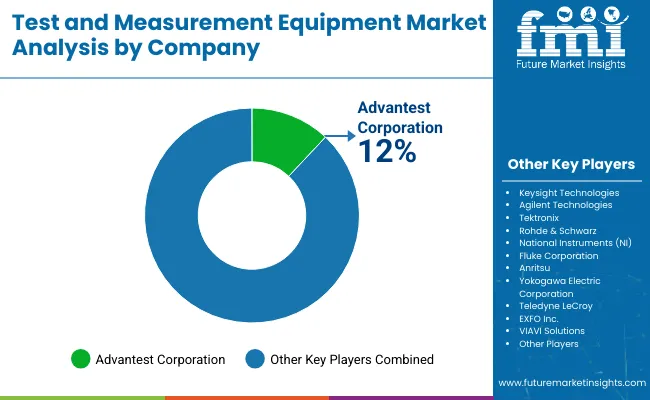
The test and measurement equipment market is driven by 10–15 major players, with the top five companies holding 55–60% of global market share, driven by their technological innovation, broad product portfolios, and deep relationships with industries like electronics, automotive, telecommunications, and aerospace. Competition primarily focuses on accuracy, precision, software integration, and automation capabilities, rather than price alone. Keysight Technologies leads the market with an 18% share, backed by its comprehensive portfolio of electronic test solutions and strong presence in high-performance sectors such as 5G, semiconductors, and aerospace.
Other leading players like Agilent Technologies, Tektronix, Rohde & Schwarz, and National Instruments maintain dominance through their advanced testing equipment, precision instruments, and deep integration with research and development, product design, and quality assurance processes. These companies offer a range of solutions from oscilloscopes and signal analyzers to automated test systems, all designed for high-demand applications in industries requiring high accuracy and reliability.
Challengers such as Fluke Corporation, Anritsu, Yokogawa Electric Corporation, and Teledyne LeCroy differentiate by focusing on specialized applications, portable test solutions, and cost-effective measurement systems for industrial, energy, and field testing. Regional players like Advantest Corporation continue to strengthen their position by focusing on specific markets such as semiconductor testing and quality control, expanding their customer base with innovative and scalable solutions.
Key Players in the Test and Measurement Equipment Market
- Keysight Technologies
- Agilent Technologies
- Tektronix
- Rohde & Schwarz
- National Instruments
- Fluke Corporation
- Anritsu
- Yokogawa Electric Corporation
- Teledyne LeCroy
- Advantest Corporation
Scope of the Report
| Metric | Value |
|---|---|
| Quantitative Units | USD 39.81 billion to USD 68.65 billion, at a CAGR of 5.60% |
| Market Definition | Test and measurement equipment encompasses instruments and systems used to evaluate, verify, and calibrate electrical, mechanical, and environmental parameters across industrial, telecom, healthcare, and defense applications. The market includes general-purpose test equipment such as oscilloscopes, signal analyzers, and spectrum analyzers, alongside mechanical test equipment for stress and materials testing. Service revenues from calibration and after-sales support form a substantial portion of market value. |
| Services Segmentation | Calibration Services, After-sales Services |
| Product Type Segmentation | General-purpose Test Equipment, Mechanical Test Equipment |
| Verticals Segmentation | Healthcare, Electronics and Semiconductor, IT and Telecommunication, Aerospace and Defense, Automobile and Transportation, Education and Government |
| Regions Covered | North America, Latin America, Europe, East Asia, South Asia, Oceania, Middle East & Africa |
| Countries Covered | India, China, Spain, USA, UK, and 40 plus countries |
| Key Companies Profiled | Keysight Technologies, Agilent Technologies, Tektronix, Rohde & Schwarz, National Instruments, Fluke Corporation, Anritsu, Yokogawa Electric Corporation |
| Forecast Period | 2026 to 2036 |
| Approach | Forecasting models apply a bottom-up methodology starting with global installed base metrics and cross-validate projections against primary research and public procurement data. |
Test and Measurement Equipment Market by Segments
Services:
- Calibration Services
- After-sales Services
Product Type:
- General-purpose Test Equipment
- Mechanical Test Equipment
Verticals:
- Healthcare
- Electronics and Semiconductor
- IT and Telecommunication
- Aerospace and Defense
- Automobile and Transportation
- Education and Government
Region:
- North America
- United States
- Canada
- Mexico
- Latin America
- Brazil
- Chile
- Rest of Latin America
- Europe
- Germany
- United Kingdom
- France
- Italy
- Spain
- Nordic
- BENELUX
- Rest of Europe
- Asia Pacific
- China
- Japan
- India
- South Korea
- ASEAN
- Australia &New Zealand
- Rest of Asia Pacific
- Middle East &Africa
- Kingdom of Saudi Arabia
- Other GCC Countries
- Turkey
- South Africa
- Other African Union
- Rest of Middle East &Africa
Bibliography
- 1. International Organization for Standardization. (2024). ISO/IEC 17025:2017, General requirements for the competence of testing and calibration laboratories. ISO.
- 2. International Telecommunication Union. (2025). IMT-2030 (6G) Framework and Requirements. ITU.
- 3. European Space Agency. (2024). Standardisation requirements for test and measurement in space programmes. ESA.
- 4. National Institute of Standards and Technology. (2025). Calibration Measurement Capabilities. NIST.
- 5. World Health Organization. (2024). Medical device technical specifications for testing. WHO.
This bibliography is provided for reader reference. The full Future Market Insights report contains the complete reference list with primary research documentation.
Frequently Asked Questions
How large is the demand for Test and Measurement Equipment in the global market in 2026?
Demand for Test and Measurement Equipment in the global market is estimated to be valued at USD 39.81 billion in 2026.
What will be the market size of Test and Measurement Equipment in the global market by 2036?
Market size for Test and Measurement Equipment is projected to reach USD 68.65 billion by 2036.
What is the expected demand growth for Test and Measurement Equipment between 2026 and 2036?
Demand for Test and Measurement Equipment is expected to grow at a CAGR of 5.60% between 2026 and 2036.
Which Services is poised to lead global sales by 2026?
Calibration Services accounts for 67.4% in 2026, given its established application base across primary end-use categories.
What is driving demand in India?
India leads at 8.3% CAGR, driven by expanding domestic production capacity and growing adoption across core application segments.
What is the China growth outlook in this report?
China is projected to grow at a CAGR of 6.3% during 2026 to 2036.
What is included in the scope of this Test and Measurement Equipment report?
Market scope includes general-purpose and mechanical test equipment, calibration services, and after-sales services. Coverage spans healthcare, electronics and semiconductor, IT and telecom, aerospace and defense, automobile and transportation, and education and government verticals, with global and regional market sizing from 2026 to 2036.
What is excluded from the scope of this report?
The scope excludes consumer-grade multimeters, educational laboratory kits without industrial certification, and standalone software analytics platforms that do not bundle with physical test hardware. Environmental simulation chambers without integrated measurement systems are also excluded.
Preview the report firsthand - request a free sample
Get SampleGet the brochure for pricing and purchase details.
Get PDFTable of Content
- Executive Summary
- Global Market Outlook
- Demand-side Trends
- Supply-side Trends
- Technology Roadmap Analysis
- Analysis and Recommendations
- Market Overview
- Market Coverage / Taxonomy
- Market Definition / Scope / Limitations
- Research Methodology
- Chapter Orientation
- Analytical Lens and Working Hypotheses
- Market Structure, Signals, and Trend Drivers
- Benchmarking and Cross-market Comparability
- Market Sizing, Forecasting, and Opportunity Mapping
- Research Design and Evidence Framework
- Desk Research Programme (Secondary Evidence)
- Company Annual and Sustainability Reports
- Peer-reviewed Journals and Academic Literature
- Corporate Websites, Product Literature, and Technical Notes
- Earnings Decks and Investor Briefings
- Statutory Filings and Regulatory Disclosures
- Technical White Papers and Standards Notes
- Trade Journals, Industry Magazines, and Analyst Briefs
- Conference Proceedings, Webinars, and Seminar Materials
- Government Statistics Portals and Public Data Releases
- Press Releases and Reputable Media Coverage
- Specialist Newsletters and Curated Briefings
- Sector Databases and Reference Repositories
- FMI Internal Proprietary Databases and Historical Market Datasets
- Subscription Datasets and Paid Sources
- Social Channels, Communities, and Digital Listening Inputs
- Additional Desk Sources
- Expert Input and Fieldwork (Primary Evidence)
- Primary Modes
- Qualitative Interviews and Expert Elicitation
- Quantitative Surveys and Structured Data Capture
- Blended Approach
- Why Primary Evidence is Used
- Field Techniques
- Interviews
- Surveys
- Focus Groups
- Observational and In-context Research
- Social and Community Interactions
- Stakeholder Universe Engaged
- C-suite Leaders
- Board Members
- Presidents and Vice Presidents
- R&D and Innovation Heads
- Technical Specialists
- Domain Subject-matter Experts
- Scientists
- Physicians and Other Healthcare Professionals
- Governance, Ethics, and Data Stewardship
- Research Ethics
- Data Integrity and Handling
- Primary Modes
- Tooling, Models, and Reference Databases
- Desk Research Programme (Secondary Evidence)
- Data Engineering and Model Build
- Data Acquisition and Ingestion
- Cleaning, Normalisation, and Verification
- Synthesis, Triangulation, and Analysis
- Quality Assurance and Audit Trail
- Market Background
- Market Dynamics
- Drivers
- Restraints
- Opportunity
- Trends
- Scenario Forecast
- Demand in Optimistic Scenario
- Demand in Likely Scenario
- Demand in Conservative Scenario
- Opportunity Map Analysis
- Product Life Cycle Analysis
- Supply Chain Analysis
- Investment Feasibility Matrix
- Value Chain Analysis
- PESTLE and Porter’s Analysis
- Regulatory Landscape
- Regional Parent Market Outlook
- Production and Consumption Statistics
- Import and Export Statistics
- Market Dynamics
- Global Market Analysis 2021 to 2025 and Forecast, 2026 to 2036
- Historical Market Size Value (USD Million) Analysis, 2021 to 2025
- Current and Future Market Size Value (USD Million) Projections, 2026 to 2036
- Y-o-Y Growth Trend Analysis
- Absolute $ Opportunity Analysis
- Global Market Pricing Analysis 2021 to 2025 and Forecast 2026 to 2036
- Global Market Analysis 2021 to 2025 and Forecast 2026 to 2036, By Services
- Introduction / Key Findings
- Historical Market Size Value (USD Million) Analysis By Services , 2021 to 2025
- Current and Future Market Size Value (USD Million) Analysis and Forecast By Services , 2026 to 2036
- Calibration Services
- After-sales Services
- Calibration Services
- Y-o-Y Growth Trend Analysis By Services , 2021 to 2025
- Absolute $ Opportunity Analysis By Services , 2026 to 2036
- Global Market Analysis 2021 to 2025 and Forecast 2026 to 2036, By Product Type
- Introduction / Key Findings
- Historical Market Size Value (USD Million) Analysis By Product Type, 2021 to 2025
- Current and Future Market Size Value (USD Million) Analysis and Forecast By Product Type, 2026 to 2036
- General-purpose Test Equipment
- Mechanical Test Equipment
- General-purpose Test Equipment
- Y-o-Y Growth Trend Analysis By Product Type, 2021 to 2025
- Absolute $ Opportunity Analysis By Product Type, 2026 to 2036
- Global Market Analysis 2021 to 2025 and Forecast 2026 to 2036, By Verticals
- Introduction / Key Findings
- Historical Market Size Value (USD Million) Analysis By Verticals, 2021 to 2025
- Current and Future Market Size Value (USD Million) Analysis and Forecast By Verticals, 2026 to 2036
- Healthcare
- Electronics and Semiconductor
- IT and Telecommunication
- Aerospace and Defense
- Automobile and Transportation
- Education and Government
- Healthcare
- Y-o-Y Growth Trend Analysis By Verticals, 2021 to 2025
- Absolute $ Opportunity Analysis By Verticals, 2026 to 2036
- Global Market Analysis 2021 to 2025 and Forecast 2026 to 2036, By Region
- Introduction
- Historical Market Size Value (USD Million) Analysis By Region, 2021 to 2025
- Current Market Size Value (USD Million) Analysis and Forecast By Region, 2026 to 2036
- North America
- Latin America
- Western Europe
- Eastern Europe
- East Asia
- South Asia and Pacific
- Middle East & Africa
- Market Attractiveness Analysis By Region
- North America Market Analysis 2021 to 2025 and Forecast 2026 to 2036, By Country
- Historical Market Size Value (USD Million) Trend Analysis By Market Taxonomy, 2021 to 2025
- Market Size Value (USD Million) Forecast By Market Taxonomy, 2026 to 2036
- By Country
- USA
- Canada
- Mexico
- By Services
- By Product Type
- By Verticals
- By Country
- Market Attractiveness Analysis
- By Country
- By Services
- By Product Type
- By Verticals
- Key Takeaways
- Latin America Market Analysis 2021 to 2025 and Forecast 2026 to 2036, By Country
- Historical Market Size Value (USD Million) Trend Analysis By Market Taxonomy, 2021 to 2025
- Market Size Value (USD Million) Forecast By Market Taxonomy, 2026 to 2036
- By Country
- Brazil
- Chile
- Rest of Latin America
- By Services
- By Product Type
- By Verticals
- By Country
- Market Attractiveness Analysis
- By Country
- By Services
- By Product Type
- By Verticals
- Key Takeaways
- Western Europe Market Analysis 2021 to 2025 and Forecast 2026 to 2036, By Country
- Historical Market Size Value (USD Million) Trend Analysis By Market Taxonomy, 2021 to 2025
- Market Size Value (USD Million) Forecast By Market Taxonomy, 2026 to 2036
- By Country
- Germany
- UK
- Italy
- Spain
- France
- Nordic
- BENELUX
- Rest of Western Europe
- By Services
- By Product Type
- By Verticals
- By Country
- Market Attractiveness Analysis
- By Country
- By Services
- By Product Type
- By Verticals
- Key Takeaways
- Eastern Europe Market Analysis 2021 to 2025 and Forecast 2026 to 2036, By Country
- Historical Market Size Value (USD Million) Trend Analysis By Market Taxonomy, 2021 to 2025
- Market Size Value (USD Million) Forecast By Market Taxonomy, 2026 to 2036
- By Country
- Russia
- Poland
- Hungary
- Balkan & Baltic
- Rest of Eastern Europe
- By Services
- By Product Type
- By Verticals
- By Country
- Market Attractiveness Analysis
- By Country
- By Services
- By Product Type
- By Verticals
- Key Takeaways
- East Asia Market Analysis 2021 to 2025 and Forecast 2026 to 2036, By Country
- Historical Market Size Value (USD Million) Trend Analysis By Market Taxonomy, 2021 to 2025
- Market Size Value (USD Million) Forecast By Market Taxonomy, 2026 to 2036
- By Country
- China
- Japan
- South Korea
- By Services
- By Product Type
- By Verticals
- By Country
- Market Attractiveness Analysis
- By Country
- By Services
- By Product Type
- By Verticals
- Key Takeaways
- South Asia and Pacific Market Analysis 2021 to 2025 and Forecast 2026 to 2036, By Country
- Historical Market Size Value (USD Million) Trend Analysis By Market Taxonomy, 2021 to 2025
- Market Size Value (USD Million) Forecast By Market Taxonomy, 2026 to 2036
- By Country
- India
- ASEAN
- Australia & New Zealand
- Rest of South Asia and Pacific
- By Services
- By Product Type
- By Verticals
- By Country
- Market Attractiveness Analysis
- By Country
- By Services
- By Product Type
- By Verticals
- Key Takeaways
- Middle East & Africa Market Analysis 2021 to 2025 and Forecast 2026 to 2036, By Country
- Historical Market Size Value (USD Million) Trend Analysis By Market Taxonomy, 2021 to 2025
- Market Size Value (USD Million) Forecast By Market Taxonomy, 2026 to 2036
- By Country
- Kingdom of Saudi Arabia
- Other GCC Countries
- Turkiye
- South Africa
- Other African Union
- Rest of Middle East & Africa
- By Services
- By Product Type
- By Verticals
- By Country
- Market Attractiveness Analysis
- By Country
- By Services
- By Product Type
- By Verticals
- Key Takeaways
- Key Countries Market Analysis
- USA
- Pricing Analysis
- Market Share Analysis, 2025
- By Services
- By Product Type
- By Verticals
- Canada
- Pricing Analysis
- Market Share Analysis, 2025
- By Services
- By Product Type
- By Verticals
- Mexico
- Pricing Analysis
- Market Share Analysis, 2025
- By Services
- By Product Type
- By Verticals
- Brazil
- Pricing Analysis
- Market Share Analysis, 2025
- By Services
- By Product Type
- By Verticals
- Chile
- Pricing Analysis
- Market Share Analysis, 2025
- By Services
- By Product Type
- By Verticals
- Germany
- Pricing Analysis
- Market Share Analysis, 2025
- By Services
- By Product Type
- By Verticals
- UK
- Pricing Analysis
- Market Share Analysis, 2025
- By Services
- By Product Type
- By Verticals
- Italy
- Pricing Analysis
- Market Share Analysis, 2025
- By Services
- By Product Type
- By Verticals
- Spain
- Pricing Analysis
- Market Share Analysis, 2025
- By Services
- By Product Type
- By Verticals
- France
- Pricing Analysis
- Market Share Analysis, 2025
- By Services
- By Product Type
- By Verticals
- India
- Pricing Analysis
- Market Share Analysis, 2025
- By Services
- By Product Type
- By Verticals
- ASEAN
- Pricing Analysis
- Market Share Analysis, 2025
- By Services
- By Product Type
- By Verticals
- Australia & New Zealand
- Pricing Analysis
- Market Share Analysis, 2025
- By Services
- By Product Type
- By Verticals
- China
- Pricing Analysis
- Market Share Analysis, 2025
- By Services
- By Product Type
- By Verticals
- Japan
- Pricing Analysis
- Market Share Analysis, 2025
- By Services
- By Product Type
- By Verticals
- South Korea
- Pricing Analysis
- Market Share Analysis, 2025
- By Services
- By Product Type
- By Verticals
- Russia
- Pricing Analysis
- Market Share Analysis, 2025
- By Services
- By Product Type
- By Verticals
- Poland
- Pricing Analysis
- Market Share Analysis, 2025
- By Services
- By Product Type
- By Verticals
- Hungary
- Pricing Analysis
- Market Share Analysis, 2025
- By Services
- By Product Type
- By Verticals
- Kingdom of Saudi Arabia
- Pricing Analysis
- Market Share Analysis, 2025
- By Services
- By Product Type
- By Verticals
- Turkiye
- Pricing Analysis
- Market Share Analysis, 2025
- By Services
- By Product Type
- By Verticals
- South Africa
- Pricing Analysis
- Market Share Analysis, 2025
- By Services
- By Product Type
- By Verticals
- USA
- Market Structure Analysis
- Competition Dashboard
- Competition Benchmarking
- Market Share Analysis of Top Players
- By Regional
- By Services
- By Product Type
- By Verticals
- Competition Analysis
- Competition Deep Dive
- Keysight Technologies
- Overview
- Product Portfolio
- Profitability by Market Segments (Product/Age /Sales Channel/Region)
- Sales Footprint
- Strategy Overview
- Marketing Strategy
- Product Strategy
- Channel Strategy
- Agilent Technologies
- Tektronix
- Rohde & Schwarz
- National Instruments
- Fluke Corporation
- Anritsu
- Yokogawa Electric Corporation
- Teledyne LeCroy
- Advantest Corporation
- Keysight Technologies
- Competition Deep Dive
- Assumptions & Acronyms Used


